"The Politics Of Shoes" The Politics of Shoes Exhibit @mobius – May 23 through May 31th, 2009
Mobius – 725 Harrison Avenue, Boston MA – www.mobius.org
by Jill Furumoto
The Red Ruby Slipper, a twisted nest of wire coiled,
A powerful red shoe, bigger than you, stands alone at the front door
Let the games begin- here, in a place called
"The Politics of Shoes"
Inside:
View
The defiled sole of a dirty shoe, A
Projectile weapon hurled at George W. Bush-
A dirty sole aimed towards another soul, tainted
with the blood the innocent.
Arrested, the shoe is shuffled away.
Step into the another puddle of sand,
Sand puddles on your shoes
Are tracked as you step across the floor to read about the
The 63 homicides that took place in Boston Last Year.
As you walk away, your footsteps
Drag the dirt around the room. Nobody is safe, even
running leaves traces of the crime scene-and panic spreads like
dust in a windstorm
Women's shoes in the corner window
High heels, pointed toes, fine leather and textiles of varied design.
These women are deceased, but their shoes endure to archive
intimate details of their lust for
beauty, style, fashion, and social acceptance...
I was told that people will judge me by my shoes (and my hair)
After I am dead, what tales will my shoes tell? No one will think much of me.
I didn't bother to dress up my feet. I have tried to free myself of
The Politics of Shoes.
Turn another corner and view- running shoes with steel protracting high heels
Can't a woman be athletic and feminine at the same time?
Where does the politics of shoes end?
Not in my backyard.
We hear these old songs, and we step over torn up sheet music.
Songs of racism and oppression are strewn all over the floor-
While scattered footprints cover their lyrics, the message is revealed
to those who look closely.
The Politics of Shoes-Where does it end?
Maybe with a click of a heel, a video loop
Two shoes knock to together, walk together, try to get along.
But this is not right, this is the bizarre tale of two left feet trying to act as a pair.
I'm ready to go home now, enough of the Politics of Shoes.
Thursday, August 13, 2009
Monday, August 10, 2009
David Chin - "The People's Shoes"
David Chin posted each of his photographs for the Politics of Shoes exhibit with the accompanying text/comment by the wearer:
http://www.prehensileeye.net/peoples_shoes/#i/01.jpg
Labels:
"exhibit",
David Chin,
photography,
shoes,
The Politics of Shoes
Monday, August 3, 2009
The Politics of Shoes: Artistic Profile Sam Tan
by Jill Furumoto
by Jill Furumoto
After viewing the Politics of Shoes art exhibit hosted by Jane Wang, many thoughts and feelings and images flooded my mind. There were so many ideas and so much to look at.
As I reflect on my experience with the Politics of Shoes show, a few of the exhibits stood out in my mind. One of them was the piece "63 in '08", by Sam Tan. This piece engaged me, and I immediate felt that I had literally "stepped into the artist's" medium when I crossed a sand puddle on the floor to read the names of the 63 homicide victims in Boston in 2008.
After reading their names, I stepped back across the sand puddle and tried to move on to the next piece. In doing so, I tracked the sand across the floor and realized that I was now part of the art piece. Yes, it made a direct impression on me. The interactive aspect of this piece grabbed me. The violence in the community rubs off on our souls or our soles, in this case, and when we try to walk away, the residue symbolically follows us. This was a great idea, and it made me stop and think about what the Artist was trying to say.
I decided that I would like to learn more about Sam Tan's artistic process and his journey towards making 63 so I interviewed him electronically and was glad he was willing to share some of his thoughts and background via facebook. Here is a summary of the interview.
Question: What is your background? Did you go to art school?
I am largely self-taught and my background was originally in psychology. I've always enjoyed visiting museums and galleries and was intrigued and inspired by the creative journeys that the artists went on. After following the programming of quite a few of the local galleries for awhile, I felt that I had the courage to jump into the deeper and see what would come out of it.
Question: What is your favorite modality?
I don't have a specific modality that I stick to. I don't like to box myself in, and I enjoy shaking things up now and then. That is why I found the open call to participate in "The Politics of Shoes to be appealing and challenging as I have not made site specific work in the past .
Question: What inspired you to do your piece 63?
Some of my work; like abstract biomorphic paintings are more intuitive and fluid in its process while others like “63 in '08” and my other work which involves using gay pornographic imagery are more conceptually based and linear in its process.
I came across the Politics of Shoes through an open call posted on the net.
The inspiration behind my piece was that I had been basically (and continue to be) troubled by the homicides that took place in the city. I wanted to communicate the idea that we are all interconnected to one another even though we may live in much safer neighborhoods that have not been a witness to such crimes.
Question: What are you working on now?
I am currently working on abstract paintings that have collage elements. Its a continuation of the work that I have shown earlier this year at the artists foundation gallery in Boston. I have no plans to make other site specific installations like "63 in '08". Although I could conceivably create variations of that work in the future.
The responses I have gotten from my piece have been good. Because of the sobering content of the piece, some viewers have been moved by it while some others were able to make interesting cross-cultural connections.
As I reflect on my experience with the Politics of Shoes show, a few of the exhibits stood out in my mind. One of them was the piece "63 in '08", by Sam Tan. This piece engaged me, and I immediate felt that I had literally "stepped into the artist's" medium when I crossed a sand puddle on the floor to read the names of the 63 homicide victims in Boston in 2008.
After reading their names, I stepped back across the sand puddle and tried to move on to the next piece. In doing so, I tracked the sand across the floor and realized that I was now part of the art piece. Yes, it made a direct impression on me. The interactive aspect of this piece grabbed me. The violence in the community rubs off on our souls or our soles, in this case, and when we try to walk away, the residue symbolically follows us. This was a great idea, and it made me stop and think about what the Artist was trying to say.
I decided that I would like to learn more about Sam Tan's artistic process and his journey towards making 63 so I interviewed him electronically and was glad he was willing to share some of his thoughts and background via facebook. Here is a summary of the interview.
Question: What is your background? Did you go to art school?
I am largely self-taught and my background was originally in psychology. I've always enjoyed visiting museums and galleries and was intrigued and inspired by the creative journeys that the artists went on. After following the programming of quite a few of the local galleries for awhile, I felt that I had the courage to jump into the deeper and see what would come out of it.
Question: What is your favorite modality?
I don't have a specific modality that I stick to. I don't like to box myself in, and I enjoy shaking things up now and then. That is why I found the open call to participate in "The Politics of Shoes to be appealing and challenging as I have not made site specific work in the past .
Question: What inspired you to do your piece 63?
Some of my work; like abstract biomorphic paintings are more intuitive and fluid in its process while others like “63 in '08” and my other work which involves using gay pornographic imagery are more conceptually based and linear in its process.
I came across the Politics of Shoes through an open call posted on the net.
The inspiration behind my piece was that I had been basically (and continue to be) troubled by the homicides that took place in the city. I wanted to communicate the idea that we are all interconnected to one another even though we may live in much safer neighborhoods that have not been a witness to such crimes.
Question: What are you working on now?
I am currently working on abstract paintings that have collage elements. Its a continuation of the work that I have shown earlier this year at the artists foundation gallery in Boston. I have no plans to make other site specific installations like "63 in '08". Although I could conceivably create variations of that work in the future.
The responses I have gotten from my piece have been good. Because of the sobering content of the piece, some viewers have been moved by it while some others were able to make interesting cross-cultural connections.
Labels:
"63 in '08",
interview,
Jill Furumoto,
profile,
Sam Tan,
The Politics of Shoes
Wednesday, July 8, 2009
Appreciating Sole Food: A Reflection on “The Politics of Shoes”
The Politics of Shoes Exhibit @mobius – May 23 through May 31th, 2009
Mobius – 725 Harrison Avenue, Boston MA – www.mobius.org
By G. Jeffrey MacDonald
The Politics of Shoes Exhibit @mobius – May 23 through May 31th, 2009
Mobius – 725 Harrison Avenue, Boston MA – www.mobius.org
By G. Jeffrey MacDonald
I thought I had a clear idea about the political nature of footwear when I arrived at “The Politics of Shoes” at Mobius in Boston on a muggy night at the end of May 2009. Seared among my preconceptions was the infamous shoe-throwing incident of 2008, when then-President George W. Bush ducked to dodge a pair of projectile insults that had, moments earlier, wrapped the feet of a Baghdad reporter. Shoes, I thought, were by definition the lowest of the low. They shield the skins of our feet from spit, spillage and everything else that ends up on the streets. To use a shoe in a political statement is to express unmitigated disgust, I assumed. I arrived ready to see what was making Boston’s artists angry enough to take aim with their shoes and fire.
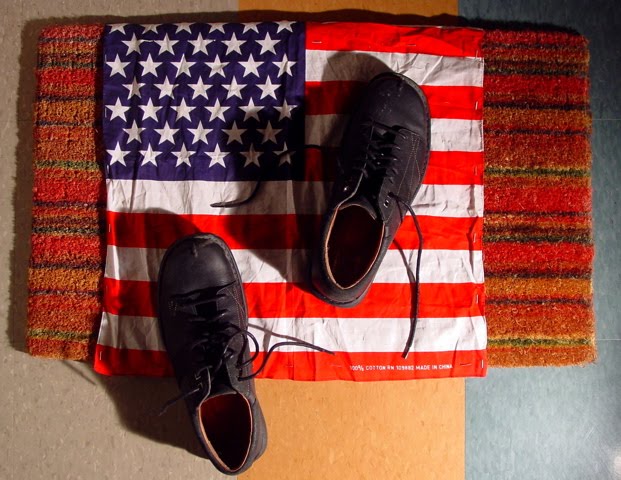
At first, I got a taste of what I’d expected from Milan Kohout’s installation: "The Politics of Shoes". Shoes photographed on a flag-draped doormat took a swipe at America’s national symbol. Another sequence of photos depicted the Baghdad shoe-throwing episode. Shoes equal insults, I thought. What other targets have these presenters lined up?
But by the time I’d finished going through the exhibit, I was seeing shoes as instruments with much more to say than: “I loathe what you represent.” I came to appreciate how shoes are deeply personal items. Hence when they’re politicized, they pack a person’s identity – frailties and passions alike – into their punch. My coming to see shoes as multi-layered vessels with subtleties to speak was a testimony, I think, to the artists’ individual and collective success at presenting installations that stretched the mind into some unexpected territory.
Sam Tan’s "63 in ’08" pushed me to a new place, even though I learned later that I hadn’t quite grasped the project. Since I visited at night, I couldn’t see the 63 Boston murder victims’ names listed on the window. I also thought the footprints in the chalk on the floor were supposed to be those of people killed (they were actually those of previous visitors to the show). But pondering the written message and studying the markings of soles in chalk, I got a strong and arguably rightful impression that a footprint – especially one of a person now deceased – is very personal, almost sacred sign. It seems to deserve protection of its integrity as an act of reverence for the one who left it. I imagined I was looking at actual footprints of young, imaginative people who’d been gunned down. Their footprints, at least figuratively speaking, were all they’d really left on this earth. How intimate it is to regard a person’s footprint, and by extension, the shoe that makes it! Perhaps a shoe isn’t merely a cold vessel of disdain and repulsion.
In the adjacent corner, my line of thinking about shoes-as-intimates found more fuel. "I dream of boots and an army of women" by Leigh Waldron-Taylor showed a semi-circle of paired shoes, all pointed at a loosely hanging ladder. Aha, I thought: a statement about social climbing. Women amass shoe collections, I inferred from the display, as a means to appear that they’re making progress up a ladder of social status. That’s so sad, I thought, but also so human. Later Jane Wang, who’d invited me to the show, noted offhandedly that these shoes had belonged to women who are now dead. That insight made the display all the more poignant to me. These women had donned what were in most cases fancy shoes. They tried to climb, never reaching the top, and then died. Now the casings that had wrapped their feet for years and protected them from the elements of New England weather were alone in this space to make a final statement. Again the intimacy, even the vulnerability, of the shoe form was palpable. These weren’t screams of insult; these were whispers of longing. Both, it seems, are woven into the power of shoes to make political statements.
As I made my way around the exhibit, I got a sense that the artists behind these artworks were in tune with the close bonds that people feel with certain favorite shoes. Lauren McCarthy’s "Dress Shoes for Spontaneous Departure" spoke of how important a shoe can be. She rendered these sneakers as her freedom, her ability to run at any second. If fashion demands heels, she seemed to suggest tongue-in-cheek, then she would absurdly weld them onto the sneakers that give her autonomy in a world rife with threats and constraints. Along the wall, David Chin’s "The People’s Shoes" conveyed how much people love their old, well-worn, simple shoes – and how ambivalent they are toward the rest. Captions to some of his 20 or so photographs of shoes worn by Mobius visitors during a SoWa Art Walk spoke to the contrast. “These are my favorites. I can wear them without socks,” said one. “These are new and don’t make me feel any different,” said another. Shoes, when loved, become a part of you and me, I gathered. Nothing the well-worn ones say – in any assemblage or act of defiance – can be divorced from the earnest aspirations of those who’ve given them a unique shape and contour.
My new appreciation for the intimacy of shoe-packaged statements made the rest of what I saw resonate on a deeper level. J. Ellis Coleman’s "Stay in Your Own Backyard" depicted oversized footprints in a suggestively enclosed space. They stood on sheet music with such racist lyrics as “a coon like you” should stay in his own backyard. I saw these footprints as a symbol of one person’s deep longings to be free, to explore and to achieve. Perhaps I would have seen them in a similar light had this installation been my first stop at the show, but the other artists’ works had sensitized me to just how inseparable are a person’s footprints from his or her being. To confine mobility, either literally or figuratively, is perhaps to muffle humanity.
It seems I don’t see shoes in quite the same way as I did before this show. More importantly, I think I appreciate the frailty of human existence more than I did before. Even the most coarse and blunt of instruments for delivering insults is apparently inextricably connected to an individual’s personal story and deep longings. And if a weapon can have such a tender human dimension, then perhaps human beings too are capable of more than a little humaneness.
BIO: G. Jeffrey MacDonald is an independent journalist specializing in religion, ethics and social responsibility. His articles have appeared in TIME magazine, USA Today, MS. magazine, American Executive, The Boston Globe, The Washington Post and The Christian Science Monitor among others. His stories in USA Today are archived here:
http://content.usatoday.com/community/tags/reporter.aspx?id=213
Jeff is a recipient of religion journalism’s top award, the Templeton Reporter of the Year prize from the Religion Newswriters Association. The American Academy of Religion has also honored him four times for his in-depth reporting on religion. He holds a Master of Divinity degree from Yale University and Bachelor of Arts in American history from Brown University.
His forthcoming book, “Thieves in the Temple: The Christian Church and the Selling of the American Soul,” will be published by Basic Books in Spring 2010.
(http://www.perseusbooksgroup.com/basic/home.jsp).
At first, I got a taste of what I’d expected from Milan Kohout’s installation: "The Politics of Shoes". Shoes photographed on a flag-draped doormat took a swipe at America’s national symbol. Another sequence of photos depicted the Baghdad shoe-throwing episode. Shoes equal insults, I thought. What other targets have these presenters lined up?
But by the time I’d finished going through the exhibit, I was seeing shoes as instruments with much more to say than: “I loathe what you represent.” I came to appreciate how shoes are deeply personal items. Hence when they’re politicized, they pack a person’s identity – frailties and passions alike – into their punch. My coming to see shoes as multi-layered vessels with subtleties to speak was a testimony, I think, to the artists’ individual and collective success at presenting installations that stretched the mind into some unexpected territory.
Sam Tan’s "63 in ’08" pushed me to a new place, even though I learned later that I hadn’t quite grasped the project. Since I visited at night, I couldn’t see the 63 Boston murder victims’ names listed on the window. I also thought the footprints in the chalk on the floor were supposed to be those of people killed (they were actually those of previous visitors to the show). But pondering the written message and studying the markings of soles in chalk, I got a strong and arguably rightful impression that a footprint – especially one of a person now deceased – is very personal, almost sacred sign. It seems to deserve protection of its integrity as an act of reverence for the one who left it. I imagined I was looking at actual footprints of young, imaginative people who’d been gunned down. Their footprints, at least figuratively speaking, were all they’d really left on this earth. How intimate it is to regard a person’s footprint, and by extension, the shoe that makes it! Perhaps a shoe isn’t merely a cold vessel of disdain and repulsion.
In the adjacent corner, my line of thinking about shoes-as-intimates found more fuel. "I dream of boots and an army of women" by Leigh Waldron-Taylor showed a semi-circle of paired shoes, all pointed at a loosely hanging ladder. Aha, I thought: a statement about social climbing. Women amass shoe collections, I inferred from the display, as a means to appear that they’re making progress up a ladder of social status. That’s so sad, I thought, but also so human. Later Jane Wang, who’d invited me to the show, noted offhandedly that these shoes had belonged to women who are now dead. That insight made the display all the more poignant to me. These women had donned what were in most cases fancy shoes. They tried to climb, never reaching the top, and then died. Now the casings that had wrapped their feet for years and protected them from the elements of New England weather were alone in this space to make a final statement. Again the intimacy, even the vulnerability, of the shoe form was palpable. These weren’t screams of insult; these were whispers of longing. Both, it seems, are woven into the power of shoes to make political statements.
As I made my way around the exhibit, I got a sense that the artists behind these artworks were in tune with the close bonds that people feel with certain favorite shoes. Lauren McCarthy’s "Dress Shoes for Spontaneous Departure" spoke of how important a shoe can be. She rendered these sneakers as her freedom, her ability to run at any second. If fashion demands heels, she seemed to suggest tongue-in-cheek, then she would absurdly weld them onto the sneakers that give her autonomy in a world rife with threats and constraints. Along the wall, David Chin’s "The People’s Shoes" conveyed how much people love their old, well-worn, simple shoes – and how ambivalent they are toward the rest. Captions to some of his 20 or so photographs of shoes worn by Mobius visitors during a SoWa Art Walk spoke to the contrast. “These are my favorites. I can wear them without socks,” said one. “These are new and don’t make me feel any different,” said another. Shoes, when loved, become a part of you and me, I gathered. Nothing the well-worn ones say – in any assemblage or act of defiance – can be divorced from the earnest aspirations of those who’ve given them a unique shape and contour.
My new appreciation for the intimacy of shoe-packaged statements made the rest of what I saw resonate on a deeper level. J. Ellis Coleman’s "Stay in Your Own Backyard" depicted oversized footprints in a suggestively enclosed space. They stood on sheet music with such racist lyrics as “a coon like you” should stay in his own backyard. I saw these footprints as a symbol of one person’s deep longings to be free, to explore and to achieve. Perhaps I would have seen them in a similar light had this installation been my first stop at the show, but the other artists’ works had sensitized me to just how inseparable are a person’s footprints from his or her being. To confine mobility, either literally or figuratively, is perhaps to muffle humanity.
It seems I don’t see shoes in quite the same way as I did before this show. More importantly, I think I appreciate the frailty of human existence more than I did before. Even the most coarse and blunt of instruments for delivering insults is apparently inextricably connected to an individual’s personal story and deep longings. And if a weapon can have such a tender human dimension, then perhaps human beings too are capable of more than a little humaneness.
BIO: G. Jeffrey MacDonald is an independent journalist specializing in religion, ethics and social responsibility. His articles have appeared in TIME magazine, USA Today, MS. magazine, American Executive, The Boston Globe, The Washington Post and The Christian Science Monitor among others. His stories in USA Today are archived here:
http://content.usatoday.com/community/tags/reporter.aspx?id=213
Jeff is a recipient of religion journalism’s top award, the Templeton Reporter of the Year prize from the Religion Newswriters Association. The American Academy of Religion has also honored him four times for his in-depth reporting on religion. He holds a Master of Divinity degree from Yale University and Bachelor of Arts in American history from Brown University.
His forthcoming book, “Thieves in the Temple: The Christian Church and the Selling of the American Soul,” will be published by Basic Books in Spring 2010.
(http://www.perseusbooksgroup.com/basic/home.jsp).
Saturday, July 4, 2009
Milan Kohout
- installation & action May 23-25 2009

composite photo:

photos: Milan Kohout (MAG)


Milan Kohout (Mobius Artists Group)
"THE POLITICS OF SHOES"
photographs, collage & political commentary
& audience participatory action/performance art
Videos of Milan Kohout's Participatory Action:
Video #1 - May 24 2009:
Video #2 - May 25 2009:
"Shoe is the dirtiest think in Iraq as you know .. therefore I put it on the hands of that tortured person american cowboys boost.. -also taken immediately when the abu graib prison scandal was exposed... even my mobius comrades were pissed about me... well while it was so so so so so obvious what this empire was doing.. but in some ways the native americans were so brainwashed and blind and did not admit that... and are still unfortunately...thereis so deep propaganda bullshit embedded in the heads of the people here that I can believe that... well fascist Germany was a similar story..
Something about our export of "democracy" ; what is also intensely interesting is that after each big bombing in IRAQ the reports said that there was a lot of shoes all around and some of them were falling from heaven seconds after the explosion...
Something relating to Bush & Shoe performance in Bagdad. This picture I took in the rebel camp in Bangkok where I performed two weeks ago -just the illustration how strong is a symbol of a shoe in those cultures.
To call somebody a dog is the worst offense in Iraq- therefore I used a dog as a symbol for our soldiers (picture taken at the beginning do the iraqi war - of-course some people here wanted to kill me for that at that time)..
Let us express the solidarity with our real performance artist from Baghdad!!!!! Those shoes on the american flag were the homage to the painting of a surrealistic artist Magritte called This is not a pipe. Did you notice? On the side of the flag there is Made in China and it is a scarf."
Milan Kohout (now a US citizen) is originally from The Czech Republic.. Here he got his M.S. in Electrical Engineering. He was an independent artist in so-called “Second Culture”. Later he becomes a signatory member and art activist of the dissident human rights organization CHARTER 77 (group of mostly artists from “Second Culture” was nominated for the Nobel Prize in 1985 and initiated non violent Velvet Revolution which toppled totalitarian regime in 1989). Following many interrogations he was forced by CZ security police to leave his country in 1986 due to his political art activism. After several years in a refugee camp he was granted asylum in the United States.
In 1993 Milan received his Diploma from the School of the Museum of Fine Arts in Boston. Since 1994 Milan has been a member of the Mobius Artists Group (www.Mobius.org). Here he has created many full-scale Performance Art pieces (both collaborative and solo) His work concentrates mostly on the subject of human rights (recently rights of Roma/ Gypsies) and politics (critique of totalitarian capitalism and fundamentalist religions) As Mobius Artists Group member he has participated on numerous international art exchange programs and festivals around the world (China, Thailand, Croatia, Taiwan, Czech Rep, Poland, Cuba, USA etc). and has been the recipient of number of awards, grants, residencies (Grant from The Fund for US Artists at International Festivals, Tanne Foundation Annual Award, First Prize at International Theater Festival in Pula, Best National Czech Independent Film Award, Arizona State University residency, PSi conference in London 2006 etc.)
http://www.mobius.org/mobius_artists.php?id=milan
Note from the Curator:
Perhaps this was really meant to be published on July 4th - Independence Day.
"THE POLITICS OF SHOES"
photographs, collage & political commentary
& audience participatory action/performance art
Videos of Milan Kohout's Participatory Action:
Video #1 - May 24 2009:
Milan Kohout : Action for The Politics of Shoes @mobius 05-24-09 from MobiusArtistsGroup on Vimeo.
Video #2 - May 25 2009:
Milan Kohout : Action for The Politics of Shoes @mobius 5-25-09 from MobiusArtistsGroup on Vimeo.
"Shoe is the dirtiest think in Iraq as you know .. therefore I put it on the hands of that tortured person american cowboys boost.. -also taken immediately when the abu graib prison scandal was exposed... even my mobius comrades were pissed about me... well while it was so so so so so obvious what this empire was doing.. but in some ways the native americans were so brainwashed and blind and did not admit that... and are still unfortunately...there
Something about our export of "democracy" ; what is also intensely interesting is that after each big bombing in IRAQ the reports said that there was a lot of shoes all around and some of them were falling from heaven seconds after the explosion...
Something relating to Bush & Shoe performance in Bagdad. This picture I took in the rebel camp in Bangkok where I performed two weeks ago -just the illustration how strong is a symbol of a shoe in those cultures.
To call somebody a dog is the worst offense in Iraq- therefore I used a dog as a symbol for our soldiers (picture taken at the beginning do the iraqi war - of-course some people here wanted to kill me for that at that time)..
Let us express the solidarity with our real performance artist from Baghdad!!!!! Those shoes on the american flag were the homage to the painting of a surrealistic artist Magritte called This is not a pipe. Did you notice? On the side of the flag there is Made in China and it is a scarf."
Milan Kohout (now a US citizen) is originally from The Czech Republic.. Here he got his M.S. in Electrical Engineering. He was an independent artist in so-called “Second Culture”. Later he becomes a signatory member and art activist of the dissident human rights organization CHARTER 77 (group of mostly artists from “Second Culture” was nominated for the Nobel Prize in 1985 and initiated non violent Velvet Revolution which toppled totalitarian regime in 1989). Following many interrogations he was forced by CZ security police to leave his country in 1986 due to his political art activism. After several years in a refugee camp he was granted asylum in the United States.
In 1993 Milan received his Diploma from the School of the Museum of Fine Arts in Boston. Since 1994 Milan has been a member of the Mobius Artists Group (www.Mobius.org). Here he has created many full-scale Performance Art pieces (both collaborative and solo) His work concentrates mostly on the subject of human rights (recently rights of Roma/ Gypsies) and politics (critique of totalitarian capitalism and fundamentalist religions) As Mobius Artists Group member he has participated on numerous international art exchange programs and festivals around the world (China, Thailand, Croatia, Taiwan, Czech Rep, Poland, Cuba, USA etc). and has been the recipient of number of awards, grants, residencies (Grant from The Fund for US Artists at International Festivals, Tanne Foundation Annual Award, First Prize at International Theater Festival in Pula, Best National Czech Independent Film Award, Arizona State University residency, PSi conference in London 2006 etc.)
http://www.mobius.org/mobius_
Note from the Curator:
Perhaps this was really meant to be published on July 4th - Independence Day.
Wednesday, July 1, 2009
Updates/Glitches
1. For some strange reason, the last two automatically scheduled Featured Artist of the Day posts didn't occur as scheduled:
6/29/09 Jane Wang and Karen Aqua was just published (on 6/30/09)
6/30/09 Milan Kohout's post will publish on 07/01/2009 at 9:00pm EST
2. Had forgotten to add Sam Tan's links to his post - they were just added.
6/29/09 Jane Wang and Karen Aqua was just published (on 6/30/09)
6/30/09 Milan Kohout's post will publish on 07/01/2009 at 9:00pm EST
2. Had forgotten to add Sam Tan's links to his post - they were just added.
Labels:
Jane Wang,
Karen Aqua,
Milan Kohout,
Sam Tan
Monday, June 29, 2009
Jane Wang & Karen Aqua
- installations
cameraphone
cameraphone
cameraphone
cameraphone
photo: Bob Raymond (MAG)Karen Aqua/Jane Wang
"Meditation on The Politics of Shoes" mixed media
shoes and death
shoe bombs
cancer cells radiation skulls animation/cartoons cute fuzzy animals?
vicious animals?
violence in Sunday morning cartoons?
shoes flung over telephone wires...
is it about ennui in youth
is it about something as innocuous as getting a new pair of shoes?
is it a neon sign saying“drugs here”?
is it about gangs and territory?
is it about someone died here/a child's sneakers?
could you fry if you touched a live telephone wire?
white for bones, red for bodies which have been skinned alive


photos: Bob Raymond (MAG)Jane Wang
"Giant Red Ruby Shoe"
electrical wire installation (outside on patio)
"Keep tight inside of them -- their magic must be very powerful, or she wouldn't want them so badly!"
- from the Wizard of Oz film with Judy Garland
Lermontov: When we first met ... you asked me a question to which I gave a stupid answer, you asked me whether I wanted to live and I said "Yes". Actually, Miss Page, I want more, much more. I want to create, to make something big out of something little – to make a great dancer out of you. But first, I must ask you the same question, what do you want from life? To live?
Vicky: To dance.
- from the Michael Powell film “The Red Shoes”
“Dance you shall,” said he, “dance in your red shoes till you are pale and cold, till your skin shrivels up and you are a skeleton! Dance you shall, from door to door, and where proud and wicked children live you shall knock, so that they may hear you and fear you! Dance you shall, dance—!”
- from Hans Christian Anderson's fairy tale “The Red Shoes”
"Something about the power of ruby/red footwear – either to empower or overpower the wearer. It's strange that both although the ruby slippers and the red shoes ostensibly represented these two very different kinds of power, the end result was similar - for wasn't Dorothy flung back (even though through her own will) from a dreamland in lurid color to an arid, Grapes of Wrath type existence in black and white – a kind of living death? And in both cases, one could only remove the red shoes/ruby slippers by dying.
Isn't that kind of weird that so many children's stories turn out to be about death?"
Jane Wang is a member of the Mobius Artists Group. Although she primarily composes music for dance, theater and performance art theater-based work, her principal instruments being double bass, piano and toy pianos, she has recently returned to her on-going love of sculpture and 3-dimensional structures. Inspired in part by the touring exhibition, Radical Lace and Subversive Knitting, and the performance artist Hanne Tierney who she frequently collaborates with, she started working in the medium of wire to create large sculptures.
http://www.myspace.com/janewangcomposer
"Giant Red Ruby Shoe"
electrical wire installation (outside on patio)
"Keep tight inside of them -- their magic must be very powerful, or she wouldn't want them so badly!"
- from the Wizard of Oz film with Judy Garland
Lermontov: When we first met ... you asked me a question to which I gave a stupid answer, you asked me whether I wanted to live and I said "Yes". Actually, Miss Page, I want more, much more. I want to create, to make something big out of something little – to make a great dancer out of you. But first, I must ask you the same question, what do you want from life? To live?
Vicky: To dance.
- from the Michael Powell film “The Red Shoes”
“Dance you shall,” said he, “dance in your red shoes till you are pale and cold, till your skin shrivels up and you are a skeleton! Dance you shall, from door to door, and where proud and wicked children live you shall knock, so that they may hear you and fear you! Dance you shall, dance—!”
- from Hans Christian Anderson's fairy tale “The Red Shoes”
"Something about the power of ruby/red footwear – either to empower or overpower the wearer. It's strange that both although the ruby slippers and the red shoes ostensibly represented these two very different kinds of power, the end result was similar - for wasn't Dorothy flung back (even though through her own will) from a dreamland in lurid color to an arid, Grapes of Wrath type existence in black and white – a kind of living death? And in both cases, one could only remove the red shoes/ruby slippers by dying.
Isn't that kind of weird that so many children's stories turn out to be about death?"
Jane Wang is a member of the Mobius Artists Group. Although she primarily composes music for dance, theater and performance art theater-based work, her principal instruments being double bass, piano and toy pianos, she has recently returned to her on-going love of sculpture and 3-dimensional structures. Inspired in part by the touring exhibition, Radical Lace and Subversive Knitting, and the performance artist Hanne Tierney who she frequently collaborates with, she started working in the medium of wire to create large sculptures.
http://www.myspace.com/
Subscribe to:
Posts (Atom)
